
Strangulation and Suffocation Charges in Wisconsin
 Estimated Read Time: 12-13 Minutes
In Wisconsin, strangulation and suffocation are legally considered the same crime and are governed by the same statute: Wis. Stat. § 940.235. While the physical actions are different, the law treats them as equal in terms of seriousness, classification, and penalties. Because they are part of the same law, a person is charged with the same felony level regardless of the actions that caused the strangulation or suffocation. It is important to approach these cases with the unwavering stance that an accusation is not a conviction, and that by diving into a fact-based analysis of the legal landscape, you can bridge the gap between complex legal code and clear, actionable insight.
Key Takeaways
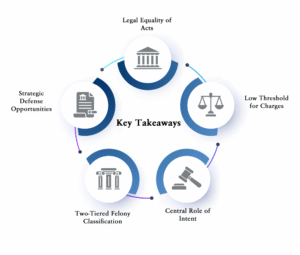
Legal Equality of Acts: Wisconsin law treats strangulation and suffocation as the same crime, applying identical legal elements and penalties to both.
Low Threshold for Charges: A person can be charged even if a victim does not lose consciousness or have visible bruises; the law only requires that breathing or blood flow was intentionally impeded.
Central Role of Intent: Prosecutors must prove the defendant had the “mental purpose” to block breathing or knew their actions were practically certain to do so, often using physical evidence, such as the duration of a grip or broken capillaries, to infer this intent.
Two-Tiered Felony Classification: Most first-time offenses are Class H felonies, but the charge is elevated to a Class G felony if the defendant has a prior conviction for a similar violent crime.
Strategic Defense Opportunities: Legal defenses often center on proving the contact was accidental, such as during a fall or reflexive movement, to show the mandatory element of intent was never met.
Strangulation and Suffocation
Strangulation and suffocation are treated as serious felonies in Wisconsin. These acts occur when someone intentionally makes it difficult for another person to breathe or blocks their blood circulation. Strangulation refers to applying pressure to the throat or neck, while suffocation refers to blocking the nose or mouth. Even though they involve different parts of the body, the legal elements that a prosecutor must prove are identical: the defendant must have intended to stop the person from breathing or to stop their blood from flowing.
This can happen by putting pressure on a person’s neck or throat, or by covering their nose or mouth. It is commonly misunderstood that the victim must pass out or have visible bruises for a crime to have occurred, when in fact, the law states that simply impeding or getting in the way of normal breathing is enough to face charges.
If convicted, the penalties for these actions are divided into two categories based on a person’s criminal record. Because they are the same charge, the penalties do not change depending on which method was used. While most first-time offenses are classified as a Class H felony, if a person has a prior conviction for a similar violent crime, the charge is bumped up to a Class G felony.
The Role of Intent
To understand how the courts distinguish between intentional actions and accidental contact, it is important to look at how the law defines the mental state of the person accused. For example, when done intentionally, it means that the person had a mental purpose to cause the specific result of impeded breathing, or was aware that their actions were nearly certain to cause that result.
When determining whether this is the case, the judge and the jury don’t just take the defendant’s word for what they were thinking. Instead, they look at the physical facts of the incident to infer what the person intended. For example, when trying to decide if an act of strangulation was intentional, the location, pressure, and duration of the touch are critical. If a person’s hand was placed around the throat in a grip fashion, or if there are broken capillaries in the eyes or skin, the court might find that this is proof of an intentional act instead of an accident. The prosecution does not have to prove that the defendant wanted to kill or even injure the victim. It is enough that they intended to impede their breathing or blood flow. As a result, even a brief squeeze that makes it hard to breathe for a moment can meet this legal standard.
In cases where the contact was truly accidental, such as during a clumsy fall, a sports injury, or a reflexive movement during a struggle, the defense might argue that the intent element of the law was never met. Since Wisconsin follows the beyond a reasonable doubt standard to convict in a criminal case, if the evidence shows the contact could have been an accident, the jury is instructed to acquit. However, if the defendant’s actions were practically certain to block breathing, the law treats it the same as if they did it on purpose.
Classification
A classification is basically a ranking system that the state uses to show how serious a crime is and how long the punishment can be. Strangulation and suffocation are categorized as felonies, which are the most serious types of crimes in the state. Strangulation and suffocation crimes usually start as a Class H felony. This standard level means a person could face up to 6 years in the legal system and a $10,000.00 fine. This is the level that applies if the person has no history of similar violent behavior.
If the person involved has certain behaviors already documented in their criminal record, the law might upgrade this crime to a more serious Class G Felony. This happens if the person was previously convicted of strangulation, suffocation, or another violent crime, such as stalking or sexual assault.
A Class G felony is much more severe, and the maximum penalty jumps to 10 years in prison and a fine of up to $25,000.00. These classifications are important because they set the limit on the amount of prison time a judge can impose.
Finally, these classifications dictate exactly how a person’s time is split between being in a cell and being monitored at home. This is part of Wisconsin’s truth-in-sentencing laws. For the standard Class H felony, the 6-year maximum is split into no more than 3 years in prison and 3 years on monitored probation. For the Class G felony, the 10-year maximum is split into no more than 5 years in prison and 5 years on supervision. Think of these classifications as a guide for the judge to follow when deciding the final punishment.
Sentencing and Additional Consequences for a Class H Felony
A conviction for a Class H felony strangulation or suffocation charge follows a strict truth-in-sentencing model. This means that if a judge sentences you to prison, you must serve every single day of that time. There is no parole to let you out early for good behavior. The maximum penalty is 6 years of imprisonment, a $10,000.00 fine, or both. This sentence will be bifurcated, meaning it will be split into two parts. A maximum of 3 years in prison is followed by a maximum of 3 years on supervised release in the community on probation. The combined total of these two parts usually cannot exceed the 6-year limit.
When a judge decides exactly how much time you should serve, they are legally required to balance three main factors established by the court case. They determine how dangerous you are to the public, how serious the specific act of strangulation was, and your personal character or past criminal record. If the situation involved aggravating factors, such as a weapon or a history of domestic violence, the judge is more likely to lean toward the maximum prison time. However, a judge may grant probation instead of prison. They can withhold the sentence, meaning they wait to see how you do on probation, or stay a sentence, which sets a specific prison term that is only triggered if you violate the rules of your supervision. Even if you receive probation, the judge can still order you to serve up to one year in the county jail as a condition of that probation.
Beyond prison time, a felony conviction for strangulation carries life-changing consequences. In Wisconsin, anyone convicted of a felony loses their right to own a firearm for the rest of their life. They also lose the right to vote or serve on a jury until their entire sentence, including all supervision time, is finished. Additionally, as these crimes are considered violent, they stay on a person’s permanent record and usually cannot be expunged or erased. This can make it very difficult to find a job or housing in the future, and can potentially act as a restrictive measure for the rest of your life.
Sentencing and Additional Consequences for a Class G Felony
A strangulation or suffocation charge is raised from a Class H to a Class G Felony if the defendant has already been convicted of a similar violent crime in the past. This higher classification significantly increases the time you face in the legal system. The maximum penalty for a Class G felony is a 10-year prison sentence and a $25,000.00 fine. This 10-year sentence is usually split exactly in half, with a maximum of 5 years in prison and 5 years on supervised release in the community. You are likely to be required to serve every day of the prison time assigned by the judge, as there is no parole to shorten the stay.
When deciding the length of the sentence, a judge will likely focus on the fact that this is a repeat offense. Because a Class G charge implies a history of violence, judges often view the defendant as a higher risk to the public, making a prison sentence much more likely than probation
Even if a judge grants probation instead of prison, they will often require a condition of time in the county jail. For a Class G felony, it is common for a judge to order up to 1 year in jail as a condition of probation. Finally, the long-term consequences are permanent. You lose your right to own or carry a firearm for the rest of your life. Additionally, because this is a more serious felony, it can be used as a strike against you, meaning any future violent crimes could lead to a mandatory sentence of life in prison without the possibility of release.
Probation or Extended Supervision
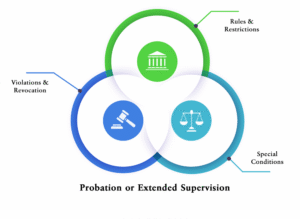
When you are placed on probation or extended supervision for a strangulation or suffocation charge, you are typically assigned a Department of Corrections agent who monitors your life closely. During this time, you must follow a long list of rules, including reporting to your agent whenever told, keeping a job, and getting permission before changing your address or traveling outside the county. Most importantly, you are strictly forbidden from possessing any firearms or dangerous weapons. Because these charges are often domestic in nature, you will almost always have a no-contact order, meaning you cannot communicate with the victim in any way, including through third parties or social media, unless a judge specifically allows it.
In addition to the standard rules, a judge might add special conditions tailored to the specific crime. For strangulation convictions, this usually includes mandatory domestic abuse intervention programs. You may also be required to undergo a substance abuse assessment and follow all recommended treatment, which often includes random drug and alcohol testing. If the court finds that mental health played a role, you might be ordered to participate in psychological counseling. Your agent has the power to search your home or person at any time without a warrant to ensure you are following these rules, a power granted to them under Wisconsin state law.
If you violate any of these rules, such as missing a meeting or failing a drug test, your agent can initiate the revocation process, which may result in your being sent back to prison to serve the remainder of your sentence. For those on a stayed sentence, revocation means going straight to prison for the exact amount of time the judge set at the beginning. For those with a withheld sentence, you are sent back to the judge for resentencing. In either case, your freedom depends entirely on strict obedience to the court’s orders.
Fines and Fees for a Class H Felony
The financial cost of a Class H Felony conviction is substantial and often overlooked. The total amount is a combination of a discretionary fine set by the judge and a series of mandatory fees and surcharges required by state law. While a judge can impose a fine of up to $10,000.00, it is unlikely that this will be the final cost. In Wisconsin, every fine is subject to a 26% penalty surcharge. This means that if a judge orders a maximum fine of $10,000, the court clerk will actually bill you for $12,600.00. This money is used by the state to fund various government programs and law enforcement training.
Beyond the fine, there are several mandatory surcharges that a judge cannot waive, regardless of your ability to pay. First, you must pay a $250.00 DNA analysis surcharge, which covers the cost of collecting and storing your DNA profile in the state database. You are also charged a $92.00 victim and witness surcharge, which supports local services for crime victims. If the strangulation involved a family member, spouse, or cohabitant, you must pay an additional $100.00 domestic abuse surcharge. There are also smaller fees, such as the $20.00 court support services fee and a $5.00 crime laboratories and drug analysis surcharge.
You might also be ordered to pay restitution directly to the victim. Restitution is not a fine; it is money paid to the victim to cover their out-of-pocket losses caused by the crime, such as medical bills for treating petechia or throat injuries, therapy costs, or lost wages if they missed work. If you are placed on probation or extended supervision, the DOC will also charge you a supervision fee of an estimated $20.00 to $60.00 per month to cover the cost of monitoring you. Failure to pay these court-ordered costs can result in the debt being sent to the Department of Revenue for tax intercept or, in some cases, can be considered a violation of your supervision rules.
Restitution Hearings
If you are convicted of strangulation and disagree with the amount of money the victim says you owe them for things like medical bills, the court will hold a restitution hearing. At this hearing, the prosecutor must prove the victim’s costs, such as hospital visits for eye injuries or therapy, were a direct result of the crime. This hearing is a formal process where your defense attorney can challenge the bills. For example, they can argue that the costs are too high, that the medical treatment was for an old injury, or that the receipts provided are inaccurate. The judge will listen to the evidence from both sides to decide on a fair total.
When setting the final amount, the judge is required to look at your financial situation and your ability to actually pay the money back. However, once the judge signs the order, that debt becomes a permanent legal obligation. Wisconsin law requires that any money you pay to the court must go to the victim first to cover their losses before any of it can be used to pay off your court fines or fees.
Even after you finish your time in prison or on probation, the restitution debt will not go away. It acts like a civil judgment, meaning the victim can use the court order to garnish your future paychecks or place a lien on your property until the full amount is paid. Because this debt can follow you for the rest of your life, the restitution hearing is a vital part of the legal process for ensuring the numbers are accurate and fair.
Ability to Pay
If a person cannot afford to pay their court costs, fines, or restitution after being released, the state provides a specific process for handling ability to pay, and a judge can grant a defendant more time to pay or set up a monthly payment plan. If someone truly has no financial means to pay, the court can sometimes waive certain discretionary fees, but it cannot waive mandatory fees such as restitution or the DNA surcharge.
However, failing to pay without a court-approved reason leads to serious consequences. If a person refuses to pay a fine or cost they are physically able to pay, the court can find them in contempt and sentence them to additional time in the county jail. Furthermore, any unpaid restitution can automatically turn into a civil judgment. This means the victim can use the judgment to place a lien on the defendant’s property or garnish their future wages, which essentially takes a percentage of their paycheck before they even receive it.
Finally, while someone is still on the community monitoring portion of their sentence, the Department of Corrections closely monitors their payments. A person’s supervision can actually be extended or even revoked if they intentionally fail to pay restitution. If supervision ends and money is still owed, the debt doesn’t disappear; it follows the person for years and can severely damage their credit score, making it difficult to rent an apartment or get a car loan.
FAQs
Can I be charged if there are no visible marks or bruises?
Yes. The legal standard for strangulation is the intentional impediment of normal breathing or circulation. Because soft tissue pressure often leaves no external trace, the State can and frequently does prosecute based on the victim’s testimony, 911 recordings, or medical evaluations of internal symptoms like difficulty swallowing or voice changes.
Can the victim drop the charges if they change their mind?
No. In Wisconsin, once an arrest is made under the Mandatory Arrest law, the victim becomes a witness for the State, not the person “pressing” charges. The District Attorney’s office has the sole authority to dismiss a case. Prosecutors often move forward with evidence-based prosecution even if the victim becomes uncooperative or recants.
When does a strangulation charge jump from 6 years to 10 years?
The charge is elevated when there is a prior violent conviction.
Class H Felony: Standard strangulation or suffocation carries a maximum penalty of 6 years (3 years initial confinement and 3 years extended supervision).
Class G Felony: If the defendant has a prior conviction for a violent crime, or the defendant has a previous conviction for strangulation or suffocation itself, the maximum penalty can potentially increase to 10 years.
Will I lose my right to own a firearm forever?
Potentially yes, in nearly all circumstances. In most cases, a felony conviction results in a lifetime ban on firearm possession in Wisconsin. Furthermore, federal law (the Lautenberg Amendment) imposes a lifetime ban on anyone convicted of a misdemeanor crime of domestic violence. This right is almost never restored unless the individual receives a formal Governor’s pardon.
Is self-defense a valid legal strategy?
Yes, but it is an affirmative defense. You must prove that you reasonably believed the force used was necessary to prevent an imminent threat of death or great bodily harm. The court applies a proportionality test, meaning the force used must match the threat. If the force used is deemed excessive or retaliatory rather than defensive, the self-defense claim will fail.
 The Use of Dangerous Weapons
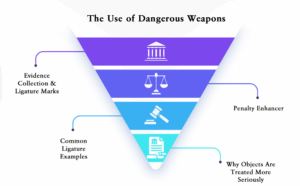
The term dangerous weapon covers more than just guns or knives. A dangerous weapon is any object that is used in a way that could likely cause death or serious injury. In cases of strangulation or suffocation, this usually refers to ligatures, which are everyday objects used to wrap around the neck or cover the face. Common examples include electrical cords, belts, scarves, or even plastic bags. While a person’s hands are used to commit the crime, state law generally does not classify bare hands as dangerous weapons; instead, the law looks for an outside object that was used to make the act more lethal.
Using one of these objects can lead to a much harsher punishment through a penalty enhancer. If a prosecutor proves a dangerous weapon was used, the judge can add extra time to the maximum prison sentence. For a standard strangulation charge, using an object like a cord can add up to 6 months of extra time onto the 6-year maximum. The law treats the use of an object as more dangerous because it can apply more consistent and intense pressure than hands alone, increasing the risk of permanent damage or death.
Even without a weapon, the act of strangulation is still a serious felony. However, when an object is involved, it changes how the police and medical teams collect evidence. They will often look for specific ligature marks, which are distinct patterns or bruises left on the skin by the object, to prove that a weapon was used. This physical evidence, combined with the presence of the object at the scene, makes it much easier for the state to seek the higher penalties associated with dangerous weapon enhancers.
Petechiae
Petechiae is one of the most significant pieces of medical evidence used in strangulation and suffocation cases. Petechiae are tiny, circular red or purple spots that appear on the skin, the whites of the eyes, or the inside of the eyelids when the tiny blood vessels, called capillaries, burst due to a sudden increase in pressure. In a strangulation event, the pressure on the neck blocks the veins from letting blood leave the head, and the stronger arteries continue to pump blood into the head. This causes the tiny vessels to pop, leaving behind these tell-tale spots.
The legal significance of these spots is specifically defined in the definition of injury. Petechiae are officially defined as “minute colored spots” resulting from blood escaping into the skin, and state law includes petechiae under the definition of substantial bodily harm. This is a critical distinction because it allows prosecutors to prove the victim was injured even if there are no large bruises, broken bones, or cuts. Because petechiae are often found in the eyes or behind the ears, they are considered high-quality forensic evidence of significant force being applied to the neck.
Think of petechiae as a silent indicator of intent. Because these spots generally do not appear from a light touch or a brief accidental contact, their presence helps the state show that the breathing or circulation was impeded. A medical expert might be called to testify that these spots are consistent with manual strangulation. This evidence is particularly powerful in cases where the victim may be afraid to testify or cannot remember the details of the assault, as the physical spots provide objective proof of what happened to the body.
Substantial Bodily Harm
Think of the term substantial bodily harm as a specific category used to describe the level of injury a person suffered. Substantial bodily harm is defined as an injury that is more serious than simple pain but less severe than a permanent or life-threatening injury. This usually means things like broken bones, stitches, or concussions. However, Wisconsin law includes a special section in this definition specifically for strangulation and suffocation cases.
Because strangulation can be deadly without leaving obvious marks like a broken arm, the law states that petechiae and bruises or contusions caused by strangulation count as substantial bodily harm. This is a powerful legal tool because it means a prosecutor can potentially prove a serious injury occurred just by showing the tiny red spots in a victim’s eyes or faint finger marks on their neck. Without this specific rule, a defendant might argue that since no bones were broken, no real harm was done.
This matters for the actual charges filed in court. For example, if a person strangles another and leaves these marks, the prosecutor may charge them with both strangulation and substantial battery. By doing this, the state is punishing the defendant for two separate things: the dangerous act of cutting off someone’s air and the physical injury that resulted from it. This can lead to multiple felony convictions from a single incident, significantly increasing the potential prison time and fines.
Great Bodily Harm
The difference between substantial bodily harm and great bodily harm is essentially the difference between a serious injury and a life-threatening or permanent one.
Substantial bodily harm includes injuries that are significant but usually heal, such as a broken nose, a concussion, or the tiny burst blood vessels caused by strangulation. On the other hand, great bodily harm is defined as an injury that creates a substantial risk of death or causes serious permanent disfigurement, or the long-term loss of an organ or body part. In the context of strangulation, this might include permanent brain damage from lack of oxygen or a crushed voice box that requires major surgery. This level of injury can elevate the charge to aggravated battery, a Class E felony, which carries a much harsher maximum sentence of 15 years in prison.
The distinction is critical for sentencing because it shifts the focus from the act of the crime to the result. While a standard strangulation charge focuses on the fact that someone’s breathing was blocked, an added charge of great bodily harm focuses on the fact that the victim’s life was nearly taken or changed forever. Because strangulation can cause internal damage that isn’t immediately visible, medical experts might need to use advanced imaging, such as a CT scan, to determine if the injury crossed the line from substantial to great.
Domestic Violence
When strangulation or suffocation happens between family members, people who live together, or people with a child in common, it is legally classified as domestic abuse. In these instances, the state has a mandatory arrest law. This means that if the police are called and see evidence of a struggle or injury, such as finger marks on the neck or tiny red spots in the eyes, they are required to arrest the person they believe to be the aggressor. Once an arrest is made, a mandatory 72-hour no-contact rule begins. During that time period, the arrested person is strictly forbidden from talking to the victim or going near their home. Breaking this rule is a separate crime that can lead to 9 months in jail, even if the original strangulation case is eventually dismissed.
Being convicted of strangulation in a domestic situation also brings extra financial and legal penalties. For example, the court must add a $100.00 domestic abuse surcharge to help fund support services for victims. Furthermore, if a person has a history of domestic violence, they can be labeled a domestic abuse repeater. This label allows a judge to add up to 2 extra years to the person’s prison sentence. The law is designed to be much tougher on domestic cases because medical experts recognize that strangulation is often a major warning sign that the violence in a relationship is becoming life-threatening.
Because these cases are so dangerous, the state often continues with the trial even if the victim asks to drop the charges. Prosecutors use physical evidence like medical reports of burst blood vessels or 911 recordings to prove what happened. They often work with victim-witness advocates who help victims navigate the court system and stay safe as the case moves forward. It is important to realize that the legal system treats domestic strangulation not just as a simple fight, but as a serious felony that requires immediate intervention to prevent future harm.
Victim-Witness Advocates
The legal process can often be overwhelming. Victim-witness advocates are professionals who work within the District Attorney’s office to help victims navigate the process. Victims of crimes like strangulation have a specific bill of rights, and it is the advocate’s job to ensure these rights are protected. They provide updates on court dates, explain what will happen during a trial, and help victims understand the truth-in-sentencing laws. They can also assist with victim impact statements, which are letters or speeches where the victim tells the judge how the crime affected their life before the final sentence is handed down.
Advocates also play a critical role in safety and financial recovery. They can help a victim apply for crime victim compensation, which is a state fund that can pay for medical bills, counseling, or lost wages if the defendant cannot afford restitution. Additionally, they help coordinate with local shelters and can assist in filing for a domestic abuse injunction or restraining order. This is a separate civil court order that can provide long-term protection.
Because strangulation is a high-risk crime, advocates often focus on safety planning. They work with the victim to create a plan for what to do if the defendant is released on bail or finishes their prison sentence. They ensure the victim is enrolled in Victim Information and Notification Everyday (VINE), an automated system that alerts the victim immediately by text or phone if the defendant is released from jail or transferred to another facility. Imagine the advocate as a bridge between the victim and the prosecutors, ensuring the victim’s voice is heard while the state focuses on the criminal charges.
 Defending Yourself
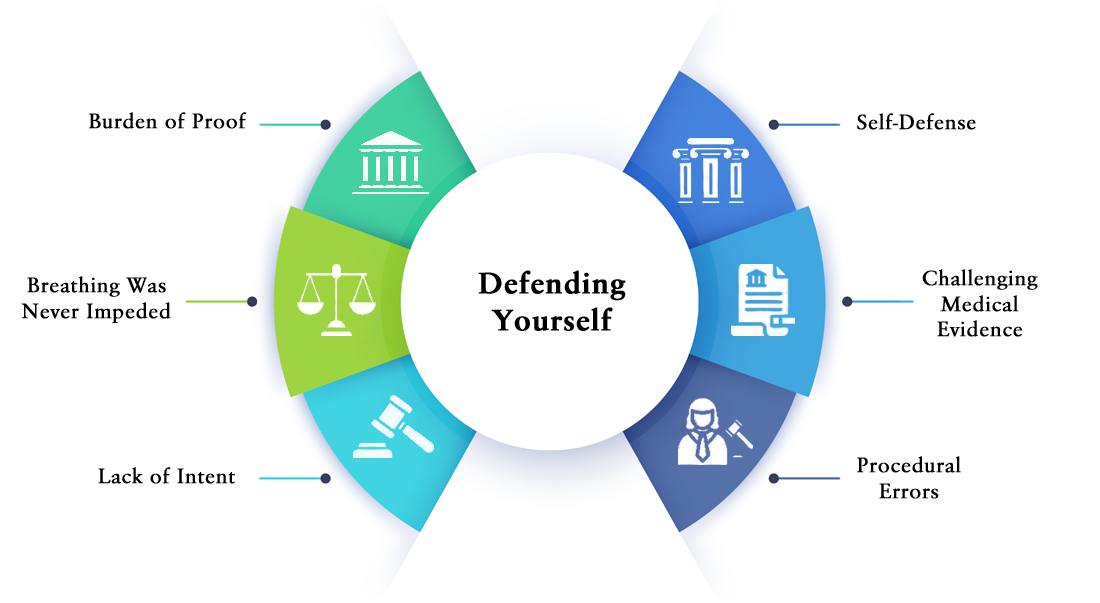
In order to defend yourself, it is important to be prepared to dismantle the state’s ability to prove the specific elements of the crime beyond a reasonable doubt. It will be the responsibility of the prosecutor to prove two things: first, that the defendant actually blocked the victim’s breathing or blood flow, and second, that they did so intentionally. A primary defense strategy is to argue that the breathing was never actually impeded. For example, an attorney might argue that while a physical struggle occurred, the defendant’s hands were on the victim’s shoulders or chest rather than the neck, or that any contact with the neck was too brief or light to actually stop the person from breathing.
Another defense approach is to show a lack of intent. Because the law requires the act to be intentional, an attorney may argue the contact was accidental or a reflexive movement during a chaotic scuffle. If the attorney can show that the defendant did not have the mental purpose to stop the victim’s breathing, the felony charge cannot stand. Attorneys also frequently use self-defense as a justification, arguing that the defendant only used force because they reasonably believed it was necessary to prevent any interference with their own body. In these cases, the lawyer will seek evidence that the victim was the initial aggressor.
Defense lawyers also heavily scrutinize the medical evidence. Since strangulation often leaves no visible marks, they may challenge the credibility of a victim’s statement if there are no physical signs like petechiae or bruising. If the state uses an expert witness, the defense may hire their own expert to testify that the marks on the victim are consistent with something other than strangling, such as a skin condition or an older injury. Finally, an attorney will look for procedural errors, such as whether the police asked leading questions to pressure the victim into saying they couldn’t breathe, or if the defendant’s rights were violated during the arrest process.
Protecting Yourself
Just because you were accused of a crime does not mean it will end in a conviction and a permanent criminal record. The majority of cases defended by Tracey Wood & Associates are resolved with charges being dismissed, reduced, or acquitted. The side that is better prepared is usually the side that achieves the outcome it seeks. There are ways to challenge the evidence against you and to assert your side of the story in court. There is a way to regain your life, your dignity, and your freedom and walk away from this as if it never happened.
Schedule a Free, No Obligation Case Evaluation
Tracey Wood and Associates delivers a decisive advantage to individuals facing charges through a free, no-obligation case evaluation. Available in person, online, or by phone, these confidential consultations are not passive reviews, but a strategic collaboration designed to bring immediate clarity, control, and direction at a critical moment. Individuals can move forward with renewed confidence after identifying a clear, actionable path. That clarity often alleviates stress, restores focus, and allows them to move ahead with composure rather than uncertainty.
Fully protected by attorney-client privilege, the evaluation is conducted with precision and purpose, and generally lasts about 30 to 60 minutes. Individuals are given the opportunity to present the full scope of their situation, address urgent concerns, and receive direct, experience-driven guidance. From that point forward, the defense team is positioned to act swiftly, preserve time-sensitive evidence, construct a tailored legal strategy, and provide a clear, written proposal for representation.
Call (608) 490-5779 or Schedule a Free Case Evaluation Online
Contact Us
Footer
Locations
Headquarters, Main Office, and Mailing Address
Tracey Wood & Associates
6605 University Avenue
Suite 101
Middleton, WI 53562
Downtown Office

Tracey Wood & Associates
345 West Washington Avenue
Suite 328
Madison, WI 53703
Tracey Wood & Associates
6605 University Avenue
Suite 101
Middleton, WI 53562
Downtown Office
Tracey Wood & Associates
345 West Washington Avenue
Suite 328
Madison, WI 53703